Winterizing a lift station in Indiana takes 4–6 hours and requires intermediate to advanced mechanical and electrical skills. Complete this process before the first hard freeze (typically late October to mid-November, depending on the region) to prevent frozen pipes, pump failure, and costly sewage backups. This guide covers the five essential steps for lift station freeze prevention, based on Indiana Department of Environmental Management (IDEM) guidelines and industry-standard cold weather pump maintenance practices. Municipal operators and rural water system managers can use this checklist to document compliance while reducing winter emergency calls.
Before You Begin: Prerequisites Checklist
Contents
- 1 Before You Begin: Prerequisites Checklist
- 2 Step 1: Inspect the Wet Well and Submersible Pump
- 3 Step 2: Install Freeze Protection for the Wet Well and Piping
- 4 Step 3: Test the Control Panel, Float Switch, and Alarm System
- 5 Step 4: Verify Backup Generator and Electrical Safety
- 6 Step 5: Check Valves, Piping, and Access Hatch Seals
- 7 Troubleshooting: Common Lift Station Winter Problems
- 8 Winter Maintenance Checklist for Rural and Municipal Lift Stations
- 9 Next Steps: Ongoing Winter Wastewater Management
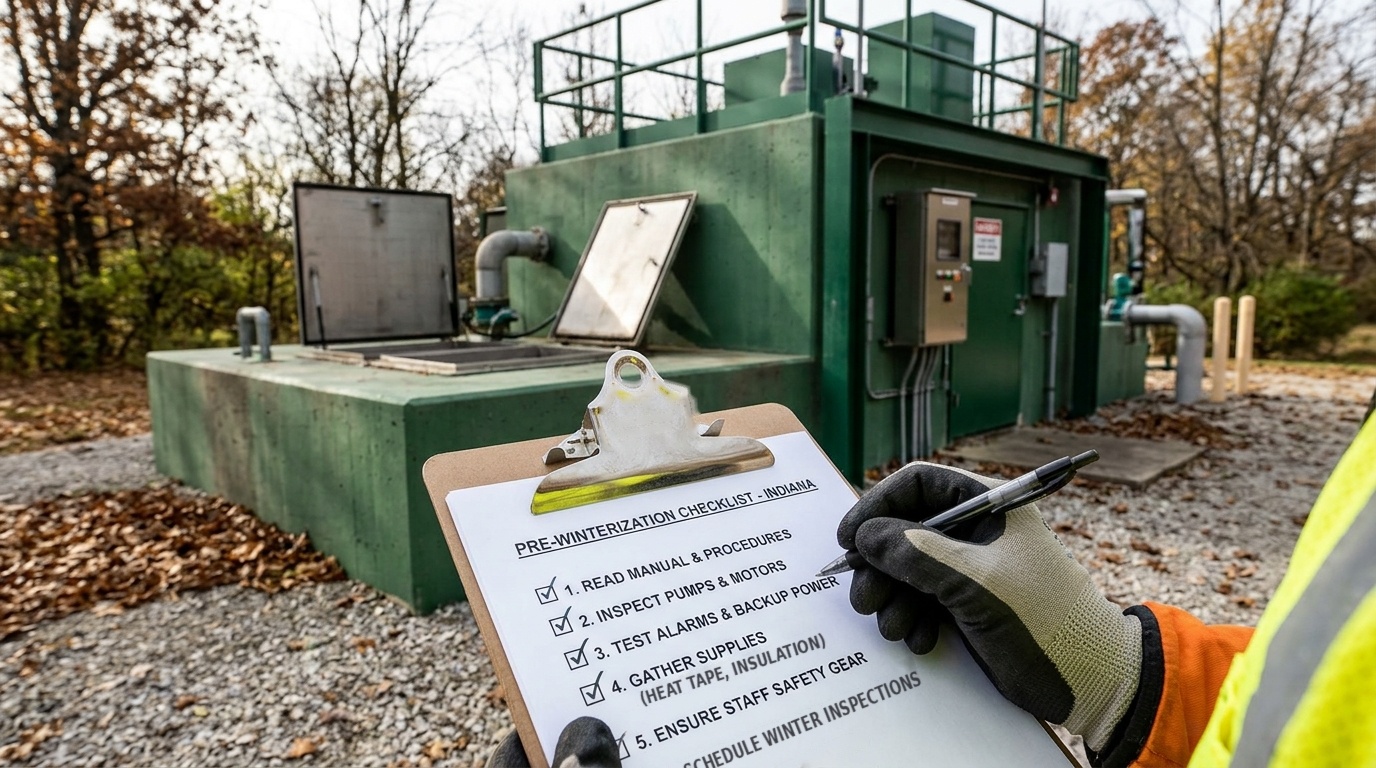
- Skill level: Intermediate to advanced (electrical and mechanical knowledge required)
- Time required: 4–6 hours for a standard municipal wastewater system lift station; add 1–2 hours for dual-pump duplex stations
- Tools needed: Heat tape rated for PVC pipe, foam pipe insulation, multimeter, megohmmeter (insulation resistance tester), flashlight, wrench set, pressure washer, hook tool, torque wrench for panel terminals, gasket sealant, silicone sealant, cold-weather valve grease
- Safety gear: Insulated gloves, hard hat, confined-space ventilation equipment, multi-gas detector (including hydrogen sulfide)
- Timing: Complete winterization before nighttime temperatures drop below 32°F for three consecutive nights
- Access: Confirm the access hatch opens freely and is not rusted shut; lubricate hinges if you feel resistance
- Documentation: Bring a maintenance log sheet or tablet to record readings for IDEM compliance files
According to IDEM (2024), lift stations serving rural water system and municipal customers must maintain operational reliability year-round, making seasonal lift station inspection a regulatory as well as practical necessity. Operators who skip pre-winter inspection risk violation notices if a freeze-related overflow reaches surface water.
Step 1: Inspect the Wet Well and Submersible Pump

Start winterizing sewage pump equipment by inspecting the wet well, the underground chamber that holds wastewater before it’s pumped to the wastewater treatment plant. A thorough inspection at this stage typically takes 45–60 minutes per pump.
1.1 Check the Submersible Pump
Raise the submersible pump along its guide rails using the lifting chain, then visually inspect the seals and housing for cracks or corrosion. A damaged seal allows water to enter the motor housing. Use a megohmmeter to check insulation resistance across the motor leads. Readings below 1 megohm indicate moisture intrusion and warrant pump removal for service.
1.2 Remove Debris from the Wet Well
Clear grease, sediment, and solids using a pressure washer or hook tool. Debris buildup reduces pump efficiency and increases freeze risk by slowing wastewater flow, a key factor in preventing frozen pipes. Stagnant wastewater freezes faster than actively flowing water, so removing solids that impede flow is a direct freeze-prevention measure.
1.3 Test the Grinder Pump (If Applicable)
For systems using a grinder pump instead of a standard submersible pump, run a manual test cycle to confirm the blades rotate freely before cold weather sets in. Listen for grinding noises or hesitation, which often signal a worn bearing that will fail under winter load.
Step 2: Install Freeze Protection for the Wet Well and Piping
Insulation and heat tracing are the core of any wet well freeze protection strategy and prevent the majority of winter pump station failures. Budget 60–90 minutes for this step on a typical duplex station.
2.1 Apply Heat Tape to Exposed Piping
Apply heat tape to exposed PVC piping and any sections above the frost line. Indiana’s average frost depth reaches 30–40 inches (National Weather Service, 2024), so all above-ground piping, and any piping buried shallower than that depth, needs protection. Self-regulating heat tape is preferred over constant-wattage tape because it automatically reduces output as pipe temperature rises, lowering energy costs and fire risk.
2.2 Add Insulation to the Pump Station Housing
Install rigid foam insulation around the pump station enclosure. This reduces heat loss by up to 40% compared to uninsulated housings (Water Environment Federation, 2023). For enclosures in open, wind-exposed rural locations, add a secondary windbreak panel to cut heat loss from wind gusts above 25 mph.
2.3 Insulate Outdoor Pump Equipment
Cover exposed valves, including the check valve and ball valve, with insulated jackets. These components are common failure points in cold climate sewage systems. Reusable zippered insulation jackets allow quick access for mid-winter inspections without removing permanent insulation.
Step 3: Test the Control Panel, Float Switch, and Alarm System
Verify electrical and monitoring components before winter storms disrupt power or communications. Allow 45–60 minutes for full control system testing.
3.1 Verify Control Panel Function
Open the control panel and check for moisture intrusion or corroded terminals. Pump control panel maintenance should include tightening all connections to the manufacturer-specified torque and testing manual override switches. Replace any desiccant packs inside the panel enclosure to prevent condensation buildup during temperature swings.
3.2 Test the Float Switch
Manually raise and lower the float switch to confirm it triggers pump activation at the correct water levels. A stuck float switch is a leading cause of winter overflow incidents. If the station has a history of condensation on the wet well ceiling, check the float cable for ice accumulation risk.
3.3 Conduct Lift Station Alarm Testing
Simulate a high-water condition to confirm the alarm system notifies operators immediately. Lift station alarm testing should occur monthly during winter months per IDEM best practices. If the station uses telemetry or SCADA (Supervisory Control and Data Acquisition) reporting, verify the cellular or radio signal strength, since snow accumulation on antennas can weaken transmission.
Step 4: Verify Backup Generator and Electrical Safety
Indiana winter storms frequently cause power outages, making backup power a non-negotiable step in lift station winterization. Plan for 45–75 minutes, including a full load test.
4.1 Test the Backup Generator
Run the backup generator under load for at least 15 minutes to confirm it can power the pump station during an outage. Generator backup for sewage pumps should provide a minimum 24-hour runtime. Check coolant and battery charge, since cold temperatures can reduce battery cranking capacity by 20% or more at 32°F compared to 70°F.
4.2 Inspect Electrical Conduit
Check electrical conduit for cracks or water intrusion points. Pump station electrical safety depends on sealed, weatherproof conduit connections, and exposed wiring is a leading cause of winter equipment failure. Apply silicone sealant to any conduit entry points showing gaps larger than 1/8 inch.
4.3 Confirm Automatic Transfer Switch Operation
Verify the transfer switch activates the generator automatically within 10 seconds of a power loss. Record the exact switchover time in the maintenance log, since delayed transfer often indicates a failing control relay that should be replaced before the first freeze.
Step 5: Check Valves, Piping, and Access Hatch Seals
The final step addresses mechanical freeze prevention for lift station piping and enclosure integrity. This step typically takes 30–45 minutes.
5.1 Test Check Valve and Ball Valve Operation
Cycle each check valve and ball valve manually to confirm smooth operation. Stuck valves in freezing temperatures can cause backflow and permit violations. Lubricate valve stems with a waterproof, cold-weather-rated grease to prevent seizing below 20°F.
5.2 Seal the Access Hatch
Inspect the access hatch gasket for cracks. A properly sealed hatch prevents snowmelt infiltration and maintains the internal wet well temperature. Replace rubber gaskets that have lost flexibility, since brittle gaskets are a common source of winter water intrusion found during IDEM audits.
5.3 Inspect PVC Piping Joints
Check all PVC piping connections for hairline cracks caused by previous freeze-thaw cycles. Replace any compromised sections before temperatures drop further. Pressure-test repaired joints at 1.5 times operating pressure for five minutes to confirm the repair holds before backfilling or re-insulating.
For municipalities and rural operators seeking professional-grade equipment and guidance, lift station winterization Indiana specialists can supply heat tape, insulation kits, and backup components rated for Midwest winters.
Troubleshooting: Common Lift Station Winter Problems
| Problem | Likely Cause | Solution |
|---|---|---|
| Pump won’t start in freezing weather | Frozen float switch or seized impeller | Thaw with a safe heat source, then test the float switch manually |
| Alarm system silent during high water | Dead backup battery or corroded wiring | Replace battery, inspect electrical conduit |
| Sewage backup after snowstorm | Frozen check valve or blocked wet well | Clear debris, insulate valve housing |
| Generator fails to engage | Low fuel or faulty transfer switch | Refuel, test transfer switch monthly |
| Cracked PVC piping | Freeze-thaw expansion | Replace section, add heat tape before next freeze |
| Telemetry signal loss during storms | Snow or ice on antenna, weak cellular signal | Clear antenna, relocate to a higher mounting point |
| Repeated breaker trips in cold weather | Moisture-compromised wiring insulation | Inspect conduit seals, replace damaged wiring |
- If the pump station loses power during a storm → start the backup generator manually and monitor the alarm system until grid power is restored.
- If water rises above the float switch trigger point → call an emergency pump service provider immediately to avoid sewage backups.
- If telemetry stops reporting → dispatch a technician for an in-person wet well check within two hours, since remote monitoring loss often coincides with the highest-risk weather conditions.
Winter Maintenance Checklist for Rural and Municipal Lift Stations
- Inspect wet well and submersible pump monthly (October–March)
- Test float switch and alarm system every 30 days
- Check backup generator fuel levels weekly during storm season
- Check heat tape and insulation integrity after major snow events
- Document all inspections for IDEM compliance records
- Rotate spare parts inventory so float switches and heat tape stay within warranty
This lift station maintenance checklist applies equally to septic system and pump station setups serving rural sewer customers, where remote locations increase the risk of delayed emergency response. Small rural operators with fewer than three staff members should consider a remote monitoring contract to supplement in-person checks during peak winter storm months.
Next Steps: Ongoing Winter Wastewater Management
After completing initial winterization, schedule a lift station inspection every 30 days through March. Rural sewage system maintenance teams should keep a spare parts inventory (float switches, check valves, and heat tape) onsite to minimize downtime. Municipal operators must retain inspection logs for IDEM review, as Indiana winter weather can shift rapidly between October and March.
Unlike summer maintenance, which focuses on odor and corrosion control, winter wastewater management prioritizes freeze prevention and power redundancy. Operators who follow this checklist can significantly reduce emergency pump failures during Indiana’s coldest months. For stations with a history of repeated winter failures, consider scheduling a professional engineering review to evaluate whether upgraded insulation, a larger backup generator, or relocated electrical conduit would reduce long-term maintenance costs.